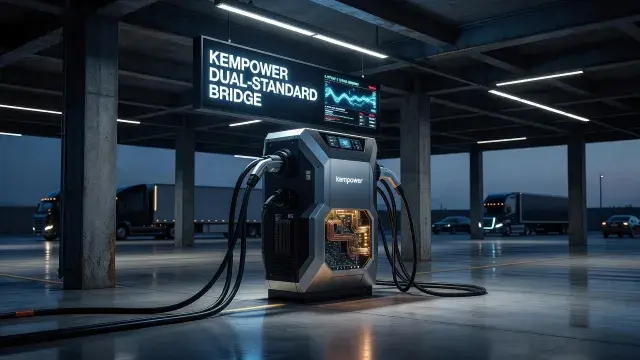
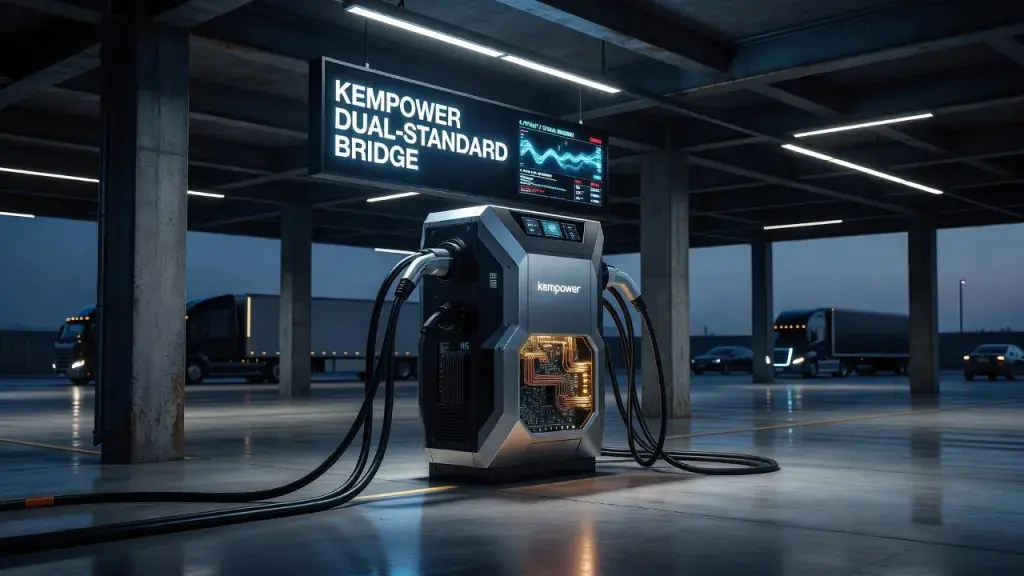
A single charging dispenser that can fast-charge a passenger sedan and then, minutes later, deliver megawatt-scale power to an electric semi truck is no longer a concept slide. Kempower has unveiled the Mega Satellite Flex, its first charger to support both the established CCS standard, at up to 560 kW, and the emerging Megawatt Charging System, at up to 1.2 MW, for heavy-duty trucks. The announcement came during the company's Unplug & Recharge event at ACT Expo, where the unit is on display this week.
The timing reflects a genuine industry inflection point. CCS has been the workhorse of electric vehicle charging for years, built around 800-amp-class hardware that suits cars, vans, and lighter commercial fleets. But heavy trucks need far more power to recharge in anything resembling a reasonable stop, which is why the industry developed MCS, a connector and protocol capable of pushing well beyond what CCS was ever designed to handle. Until now, operators wanting to serve both vehicle types have effectively needed two separate systems, doubling equipment costs and site complexity. That kind of infrastructure fragmentation echoes concerns familiar to anyone comparing regional service gaps elsewhere online, the same way travelers sometimes discover that using Disney Plus from another country requires entirely different technical workarounds depending on where they are. using Disney Plus from another country
One Site, Two Charging Standards
The Mega Satellite Flex is built to remove that duplication. Operators can install one dispenser capable of serving both standards from day one, rather than building CCS infrastructure now and retrofitting or adding MCS hardware later as truck adoption grows. The unit supports up to 1,500 amps on the MCS side and 700 amps for CCS, with cable lengths of 5 meters for CCS and 2.7 meters for MCS. An integrated payment terminal option is also available, which matters for sites serving mixed public and commercial traffic.
There's a secondary benefit tied to the shift toward 800-volt vehicle architectures, increasingly common in newer EVs designed for faster charging. A charger capable of higher voltage and current ranges is better positioned to serve that next generation of vehicles without another hardware upgrade cycle. For site operators, this translates directly into utilization: a charger that can serve more vehicle types, more often, reaches profitability faster than one limited to a single segment.
Why Utilization Drives the Business Case
Charging infrastructure economics hinge on how often a unit is actually delivering power rather than sitting idle. Dedicated truck charging corridors face a particular problem early on: truck volumes are still low relative to passenger EVs, meaning MCS-only hardware can sit underused for long stretches. By making a single dispenser capable of serving both markets, Kempower is effectively hedging that risk for operators, letting the same investment capture revenue from whichever vehicle type shows up.
The Mega Satellite Flex is also designed to integrate with Kempower's existing distributed charging architecture, meaning operators already running Kempower systems won't need a separate control or power-sharing setup to bring it online. That compatibility could matter as much as the raw power specifications, since integration friction is often what slows real-world deployment of new charging hardware.
What Comes Next
Kempower expects the Mega Satellite Flex to reach the market in North America and Europe in July 2026, giving fleet operators, charge point operators, and site developers over a year to plan deployments around it. Whether the dual-standard approach becomes an industry norm or remains one manufacturer's answer to a transitional problem will depend largely on how quickly MCS adoption accelerates among truck manufacturers and fleets over the next few years.