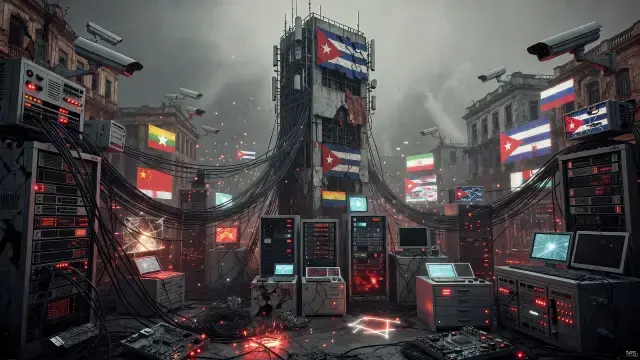
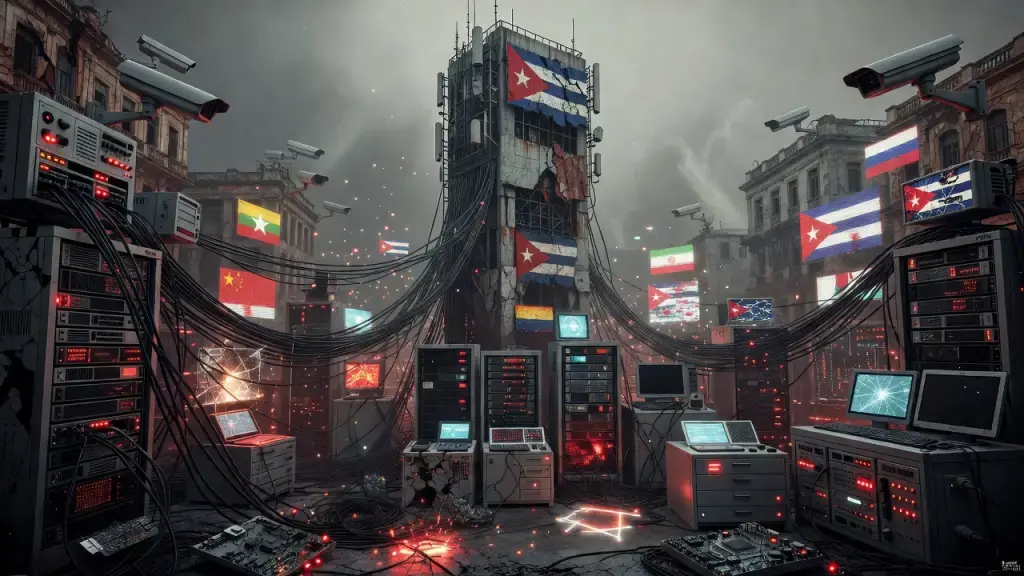
Cuba has scored 19 out of 100 in Freedom House's latest global assessment of internet freedom, placing it among the five most restrictive countries in the world. The report classifies the island as "Not Free," citing pervasive censorship, systematic state surveillance and persistent violations of users' digital rights. Cuba sits alongside Myanmar, China, Iran and Russia at the bottom of the rankings, and remains the lowest-scoring nation in all of Latin America.
What the Report Measures
Freedom House's annual study evaluates 38 countries, assessing how government policy shapes access to the internet, how freely information circulates, and how well individual digital rights are protected. The methodology looks beyond simple connectivity statistics. It examines whether governments block websites, throttle connections during moments of unrest, prosecute citizens for online speech, or deploy technical tools to monitor private communications. A low score reflects not one single abuse but a pattern: infrastructure, law and enforcement working together to narrow what citizens can say, read and organize online.
How Control Is Exercised in Cuba
Cuba's internet architecture gives the state an unusual degree of leverage. Connectivity runs through infrastructure controlled by the government-run telecommunications monopoly, which means access, pricing and availability can be adjusted centrally, often in response to political circumstances rather than purely technical needs. This concentration of control allows authorities to slow or suspend mobile data during protests, restrict access to independent news outlets, and monitor activity on platforms used for organizing or dissent. Legal frameworks reinforce these technical controls, criminalizing certain forms of online expression and giving officials broad authority to act against content deemed subversive.
For ordinary users, this translates into a digital environment shaped by caution. Many Cubans rely on informal networks, offline file-sharing systems and intermittent access points to share information that cannot move freely through official channels. These workarounds reflect a broader global pattern: where state control over infrastructure is high, citizens often improvise alternative distribution methods that fall outside formal oversight, precisely because centralized networks are the easiest to monitor and restrict.
Dissent Persists Despite the Risks
Freedom House's report makes a point of noting that repression has not eliminated critical voices. Despite the considerable risks associated with online mobilization in Cuba, forms of dissent continue to surface, whether through social media posts, independent journalism operating under pressure, or coordinated efforts to document events the state would prefer to keep hidden. This resilience illustrates a recurring tension in heavily controlled information environments: technical and legal barriers can raise the cost of speaking out, but they rarely eliminate the motivation to do so.
Why the Global Pattern Matters
Cuba's position alongside China, Russia, Iran and Myanmar is not coincidental. These governments share a common approach: treating internet infrastructure as a lever of political control rather than a neutral utility. For international observers, the ranking serves as a reminder that access to connectivity does not guarantee access to information. The gap between being "online" and being "free online" is where much of the modern struggle over digital rights now plays out, and Cuba's score is a stark illustration of how wide that gap can become.